Introduction to Jamaican Food and ItalThe truth is, I don't have any experience with Jamaican cooking, though I intend to explore more in the future. I also never explore other cultures through food, nor write about them, with any intention of being a voice with any kind of authority. I love food, I love exploring the world through flavour, and any information I share is from my own limited research and shouldn’t be taken any further than that. With that said, I recently came across a post that touched on its history and roots, and I was immediately inspired. What stood out was the concept of Ital. In Rastafari culture in Jamaica, Ital (pronounced eye-tal) stems from Rastafarian beliefs and refers to natural, pure, minimally processed food. It is often plant-based and can include stews of root vegetables simmered in coconut milk and spices, but it also encompasses many other simple preparations. Think organic, natural, preservative-free, and often even free of added salt. To understand Ital, it is perhaps helpful to first understand Rastafari beliefs. Within Rastafari thought, there is an emphasis on Livity, a divine life force or spiritual vitality believed to flow through all living things. A core tenet is that food should be natural, pure, and from the earth, and should enhance life force rather than diminish it. Many Rastafarians are vegetarian. Some consume small amounts of fish, and some follow a strictly vegan diet, though practices vary widely. What stands out most about this to me is the juxtaposition with mainstream Western veganism, which is sometimes criticized for centering whiteness. I am not a voice of authority on racial theory. I am a learner, but I think I can say this critique is not without credibility. We need to look no further than colonization to understand how many traditions, ideas, and beliefs we integrate into our lives without acknowledgment of their origins. Decolonization work does not ask us to be perfect, but it does ask us to recognize the cultural and historical roots of practices we adopt, and to consider how human and animal liberation movements intersect rather than exist in isolation. Tips For Making A More Authentic Jamaican Curry
This version of my recipe is so much more thoughtful than the first one I tried to make, where I grabbed a Jamaican curry blend from the store, and left it at that.
For this version I did a bit of research and landed on a few important things to help it lean towards something a bit more authentic. (though I am no authority on the matter) 1. Habanero Peppers — I don't have much experience using all the different kinds of peppers, but when I read that Habaneros were commonly used in a Jamaican Vegetable Curry I had to go for it. The method is what appeals to me most. The whole pepper just goes right into the stew. One, two or even three depending on how much heat you want. Then you can remove them. Another tip is that piercing them will help release more heat. In my opinion, this dish really needs heat to balance the natural sweetness from the sweet potatoes and coconut milk. I wouldn't enjoy the sweet leaning flavours without the added heat to cut through it. And I was pleasantly surprised by how much I loved the particular heat from the Habaneros. Well rounded and warm. Delicious. 2. Making Your Own Jamaican Curry Blend + Thyme Sprigs— Instead of using a store bought blend, I made my own which was easy. All Spice is an important ingredient, and even if you do pick up a store bought blend, if it doesn't include all spice make sure to add it separately. For the thyme, I would use fresh sprigs if I had them, but I had some from my garden that I dehydrated. I tossed them in, then plucked out the stems later on. All the leaves had fallen off, and it worked perfectly. Step By Step Instructions for making Jamaican Vegetable Curry
1. Sweat onion, ginger and garlic in coconut oil along with a pinch of salt and pepper until soft and translucent. Add 3 tbsp of the home made Jamaican Curry Spice Blend.
2. Add 2 sprigs of fresh thyme (I used whole sprigs from my garden I had dried) and 1 or 2 whole, fresh Habanero Peppers. (I omitted Cayenne Pepper from my home made spice blend, and added two whole habanero peppers, I didn't find it overly spicy, but this is subjective of course.) *** Pierce the habanero peppers with a knife to release more heat
3. Add diced sweet potatoes, and stir into the spices. I chose a purple skinned and white flesh variety, which is a bit less sweet than the typical orange variety. Anything works but less sweet is good here in my opinion.
4. Add water and both cans of coconut milk, you want to just cover the sweet potatoes. Bring to a boil and reduce to a simmer. Cook until potatoes are tender and liquid has reduced to your liking.
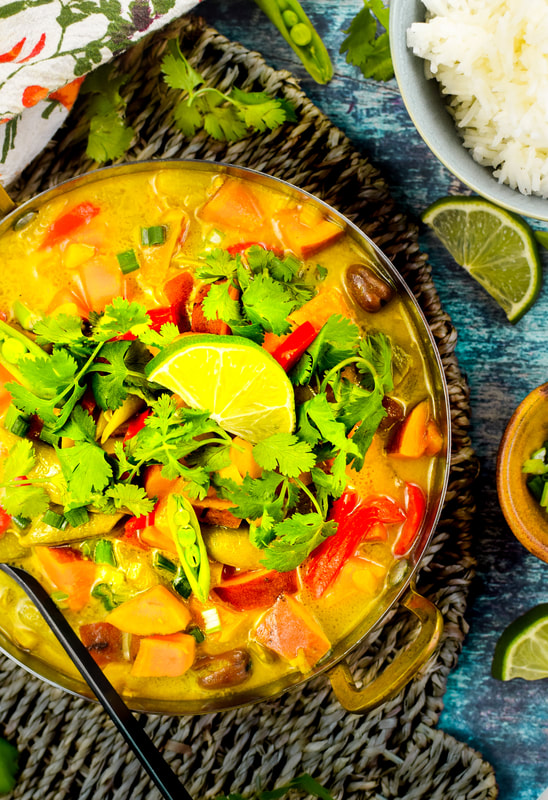
5. When the liquid has thickened from reducing, you can add your bell peppers, snap peas and kidney beans. Cook just a few minutes until veg is tender crisp.
6. Taste and adjust seasoning. Remove Thyme sprigs, and if desired the whole habanero peppers. Garnish stew with Cilantro and lime wedges. Serve with Rice and Roti (a flatbread) for scooping.
0 Comments
Leave a Reply. |
Author I’m Trisha, a classically trained chef in Epekwitk, (Prince Edward Island), Canada. Archives
March 2026
|


RSS Feed